

Kim Fahner discusses form, mythology, intuition, and The Pollination Field in our latest Quatrains Questions interview.
Q: What were your principals for organization with The Pollination Field?
It always seems that I have a sequence for a manuscript when I first send it in to a publisher, but by the time it comes out the other end—when it has a cover and spine and is finally in book form—the architecture of the thing has evolved into something different.
Initially, I started the entire ‘bee poems sequence’ with the long tale that comes at the beginning of the book. It felt like a myth, or a legend, and it has always had a kind of storytelling, rolling feel to it when I read it out loud to myself. It reminded me of the oral tradition of poets in Ireland, who traveled from chieftain to chieftain, recounting stories of old in the evenings. I’d never written anything like that prose-y and mythic in tone before, so it startled me a bit. Then I continued with writing other types of bee poems—around places (like Ireland, Scotland, Egypt, Vancouver Island, and Nova Scotia, just to name a few). As I went on with the project, I explored various species of bees, as well, and so the groupings came together naturally.
The final structure didn’t reveal itself until I started working with my editor, Alice Major. I find that working with an editor, as a poet, is helpful. Often, you’re knee or hip deep in your work, so you can’t see the various ways in which the structure could work. Alice is someone whose work I have admired for years, and as I was still writing more of the mythic pieces about the queen bee figure, she suggested that those become touchstone sequences throughout the manuscript.
Q: Throughout The Pollination Field you have paid particular attention to form and its use. What is your approach to this? Do you start with an objective of writing a piece in a particular way or does the poem as it evolves dictate the form and approach?
I had always been nervous (maybe even fearful!) about playing and experimenting with poetic form, so when Yvonne Blomer offered a week-long immersion course in poetic line and form at the Metchosin International Summer School for the Arts (MISSA) on Vancouver Island in Summer 2022, I jumped at the chance to really study form and line in person. That’s where I got hooked on forms like triolets, duplexes, and even long-lined couplets. The various forms allowed me to explore my topic of interest in a new way, and I feel I’m a stronger poet for it all.
I wanted to feel stronger working in certain forms, so I purposefully set myself the task of trying to practice writing in a variety of forms that were new to me. I honed the craft over a couple of years, and if a poem didn’t “fit” a particular form, then I would consider other forms that might suit it better. I think it’s important to practice forms, and to consider line breaks carefully, but I also think it’s important to know when something doesn’t fit the form you started out with on the page or screen. There’s a place where knowledge, practice, and intuition come together and guide me as I write.
Q: “Tell the Bees” explores a Celtic ritual of sharing the news of one’s passing with the hive. What role does tradition and/or mythology play in The Pollination Field?
I first learned about the sacred role of bees and their hives in Irish culture when I visited Ireland in September 2018. I was visiting my friend Frances at her cottage in Spanish Point, Co. Clare, Ireland, and one of the books on her bookshelf was about the Brehon Laws. These are ancient Celtic laws that were followed in the west of Ireland, in particular, and I was drawn to the power that women were assigned in that time period, but also to the holiness attributed to bees and the natural world. I remember, too, my great-aunts telling me the story of tiny white moths or butterflies being visitors from the spirit realm, so that was also in my head while I began to explore how myth worked its way into The Pollination Field. Part of the research that I did for this collection of poems included a close reading of the Bechbretha (or “Bee Judgements”) that are in the Brehon Laws. For the early Irish, bees were perceived as intermediaries between this world and the next. In most of the Irish lore I’ve studied, including the immram motif that appeared in Emptying the Ocean (Frontenac, 2022), there is a lot of physical traveling that mirrors the spiritual in between world or inter-dimensional journeying.
In The Pollination Field, my love of mythology and lore has woven itself into my own creation of the queen bee stories that play out in the various ‘tales.’ It’s not just a single female essence or persona that evolves, but one that is multi-faceted.
I feel that women, especially at perimenopause and menopause, come to a place where they can look back over their lives so far and take stock of how many incarnations they’ve had in just this one physical life. If open to transformation (which includes a lot of work and awareness of self), then there are always possibilities for growth. It’s never comfortable, to do internal or therapeutic work, but it’s a life-long learning that helps you to evolve and blossom as you age.
Q: Revisions—some poets love them, some dislike them. What’s your take on this editorial stage? How do you approach revising and restructuring your poems? How do you know if a poem is ready or not to head out into the world?
I think revision is crucial to strengthening a poet’s work. I read stories of poets who say that they just trust their first drafts implicitly, but to me that feels ridiculous. The longer I’ve been at this, the harder I tend to be on my work. I’ve learned to be less overprotective of it, to trust that there are other, more experienced poets who will come along and give me feedback that might make my work stronger.
I always leave my pieces for a time, and then come back to them. I used to not trust my own instincts about revision and edits, but I do more now—I think just because I’ve been doing it for a long time. I’m less precious about what I keep, and what needs to be cut out or reworked. I think of it as trimming a bonsai tree or something like that. My friend, Bob Stewart, who’s a poet in Windsor, once said to me “See what’s scaffolding, and get rid of that …” The first stanza, I often find, is usually extraneous. Bob was right, and it’s been a tool for revising that I’ve used since he shared it with me.
As to when a poem is right for the world, that’s a good question. I think it helps to read poetry every day, and to read poetry that is outside your comfort zone, so that you can see what other poets are doing with their craft and style. There’s an intuitive ping that happens for me when I think a poem is ready to go out on its own. That said, I’ve had a number of ping poems bounce back to me as rejections. I just keep on submitting; rejections are part of what make us better craftspeople, I think. I don’t take them personally, and I keep trying to improve my understanding and knowledge of poetry by taking classes, challenging myself to try new poetic forms and styles, and reading widely.
About The Pollination Field
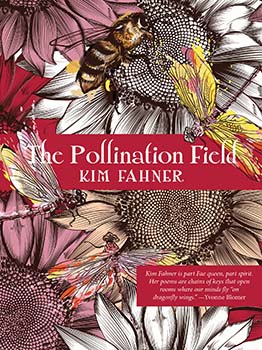
Kim Fahner is part Fae queen, part spirit. Her poems are chains of keys that open rooms where our minds fly “on dragonfly wings.” —Yvonne Blomer
Kim Fahner’s The Pollination Field is a poetic foray into the literal and metaphorical world of bees, but it also includes an exploration of other pollinators—bats, beetles, birds, butterflies, dragonflies, and even humans. In these poems, Fahner continues with her poetic observation and documentation of how the human world impacts the environment, but also incorporates myth and feminism in her consideration of how women evolve over time.
 Turnstone Press Ltd.


